
Sequence of Operations: Why It Matters for Lighting Controls to Perform as Expected
What is a Sequence of Operations?
A Sequence of Operations is the “rulebook” for any lighting control system. It outlines how the system should behave — when lights turn on or off in response to daylight, occupancy, and unoccupied times. The document ensures that everyone involved, from manufacturers to programmers to building occupants, knows what to expect during design, installation, and occupancy.
Typically derived from a Control Intent Narrative, the Sequence of Operations provides the technical details needed to program and explain the advanced lighting system’s functions. It offers clear, step-by-step instructions for how the system should operate in various scenarios, answering not just
“What should it do?” but “How will it do it?”
Why it matters
Knowing what a sequence of operations is — and asking for it — can save time, money, and headaches in any lighting controls project. It can serve as a contract document defining specific set points and criteria for when the installation and setup are considered complete.
Lighting controls save energy, improve occupant comfort, and help meet code requirements. However, without a clear plan, these systems can fall short of expectations. Poorly implemented controls can frustrate owners and occupants, miss eligibility for utility incentives, and even result in failed inspections that delay project completion
A well-written sequence of operations:
- Impacts how much energy will be saved
- Reduces costly rework and change orders
- Ensures the delivered system matches expectations
- Simplifies system commissioning and troubleshooting
- Provides an operational guide for facilities staff and occupants to explain what to expect from the lighting system and identify maintenance needs
When should it be developed?
Timing is everything! It will vary by project type, but in general it should be developed prior to quotation of the system, i.e., submittals or construction documentation for new construction and equipment installations for retrofits.
Who should be involved?
While different people have a role in creating, reviewing, or using the sequence of operations, there’s no single party responsible for its creation. It can vary from project to project, so it’s important to clearly define who is responsible from the start and ensure all parties are aware it exists.
Common roles include:
- Building Owners & Facility Managers
Define goals and approve final system requirements - Electrical Contractors and Installers
Assist in defining wiring and programming - Control Vendors
Provide product-specific capabilities guidance
- Lighting Designers
Design the lighting control system - Commissioning Agents & Inspectors
Verify that systems operate as documented
What does a Sequence of Operations look like?
A lighting control system sequence of operations will vary based on the system, the type of space, and the intended control strategies and devices. These may include occupancy sensing, daylight harvesting, scheduling, manual control, trim adjustments, demand response, and other functions. In general, a sequence of operations consists of short written descriptions for each space, tables outlining conditions and corresponding lighting responses, and diagrams or flowcharts illustrating control logic.
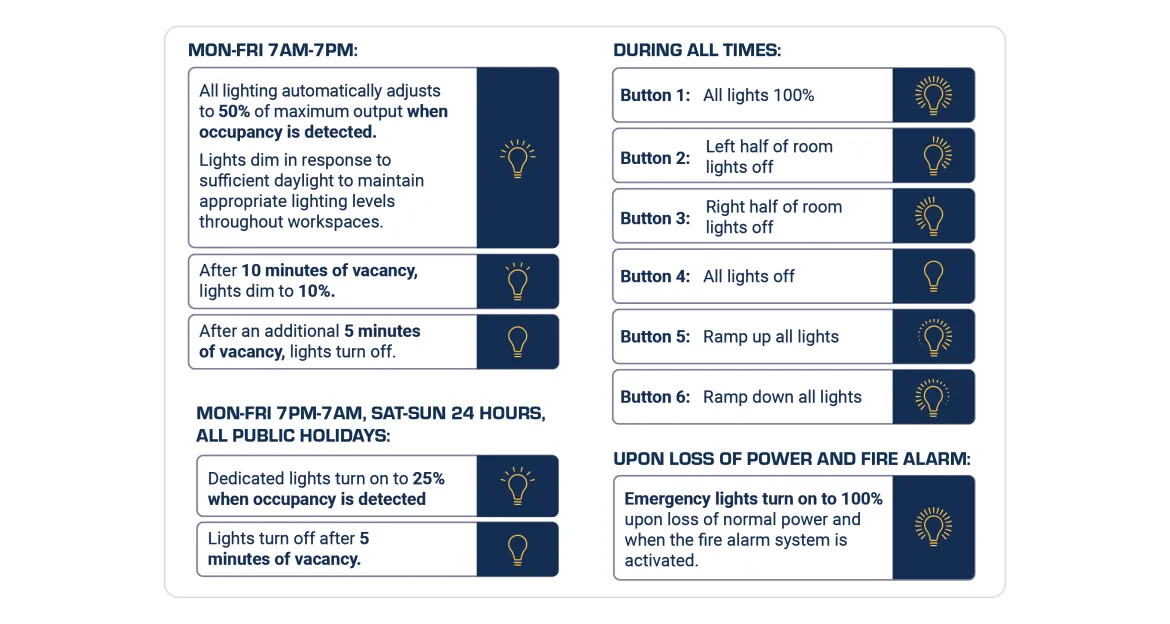
The following is an example of a simplified sequence of operations for an open office area.
- Lighting dims continuously in response to occupancy and daylight sensors.
- Lighting is programmed through a time clock to account for weekday, weekend, and holiday schedules.
- Lighting is capable of manual override using wall stations.
Settings include:
How to proceed
- Ask for a sequence of operations early. The earlier it’s documented, the fewer surprises there will be during installation or inspections.
- Review carefully. Make sure it matches the building’s needs and operations.
- Keep it on file. It may be needed for future troubleshooting, maintenance, or renovations.
- Use it for training. New staff will appreciate knowing how systems should behave.
- Additional resources about the process of writing and utilizing a sequence of operation are available below from many reliable industry associations.
Ready to learn more?
Explore additional resources to deepen your understanding of how to write and apply a sequence of operations effectively.
- Controls: How to Write a Smart Sequence of Operations – A free resource that provides terminology definitions and an application example.
- ANSI/IES LP-16-22: Documenting Control Intent Narratives and Sequences of Operations – An extensive overview of what CINs and SOO are and how to construct them, including examples. Note: access to this resource requires purchasing.
- NEMA LSD 64: Lighting Control Narrative – Provides definitions of terminology related to lighting controls systems. Note: access to this resource requires purchasing.