
Luminaire-Level Lighting vs. Standalone Controls
This guide outlines the competitive advantages of Luminaire-Level Lighting Controls (LLLCs) over standalone controls.
Audience & Intended Use
This guide has been crafted to support the sales process between contractors and their customers.
|
Contractors |
Building & Business Owners |
|---|---|
|
Supports project proposals by highlighting |
Informs decision-makers of LLLC |
Understanding the Limitations of Standalone Controls:
Standalone controls are the most common example of code-minimum solutions available and purport to
meet energy code requirements at the lowest upfront cost.
Standalone controls are designed to be basic. They rely on wired connections, have limited functionality, and
are not networked. These limitations complicate installation, increase operations and maintenance costs and
decrease user acceptance. As a result, standalone controls are prone to complaints from both tenants living
with the system and the contractors who deal with callbacks.
| Feature | Standalone Controls | LLLCs |
|---|---|---|
| Sensor Coverage |
Prone to blind spots that can turn lights off when spaces are still in use | Integrated sensors in every fixture provide robust sensor coverage |
| Flexibility | Requires an electrician to rewire zones when space use changes | Capable of being rezoned and reconfigured via app based configuration tools without |
| Ease of Use | Limited configuration methods | Range of configuration methods including user friendly app-based tools |
| Capabilities | Limited to the most basic control strategies |
Integrates basic and advanced control strategies into every fixture |
| Networked | Hardware is static and not capable of communicating with other devices or receiving firmware updates | Hardware is networked and can receive system updates that increase capabilities and ensure lasting functionality |
Advantages of Flexible Lighting Control Solutions
When the average lifespan of a building is 50–60 years, it pays to think about the future.
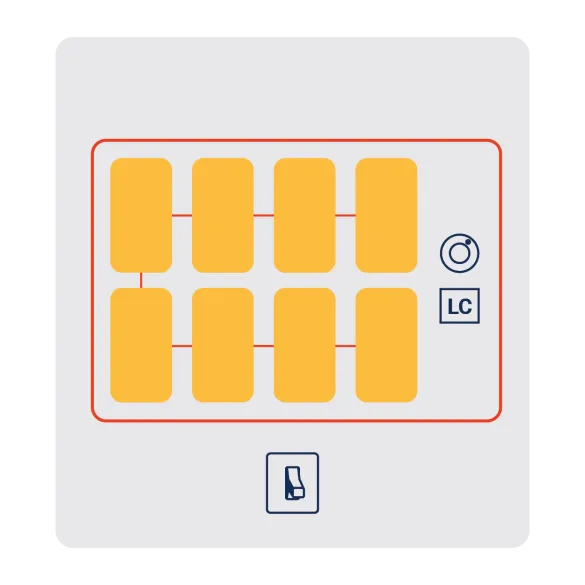
| Standalone Controls Are Static and Hide Their True Costs |
Standalone controls are zone limited and |
|---|---|
|
Standalone controls rely on wiring to create static zones that cannot be modified without rewiring. On paper, designing with a single load controller and sensor for each zone may appear to reduce The reality is that zone-limited systems that rely on wiring are more prone to cost overruns from as built scenarios, which add pipe and wire costs and increase labor. These costs are further multiplied over the lifecycle of the system when space uses change and building owners accommodate tenant improvements. |
|
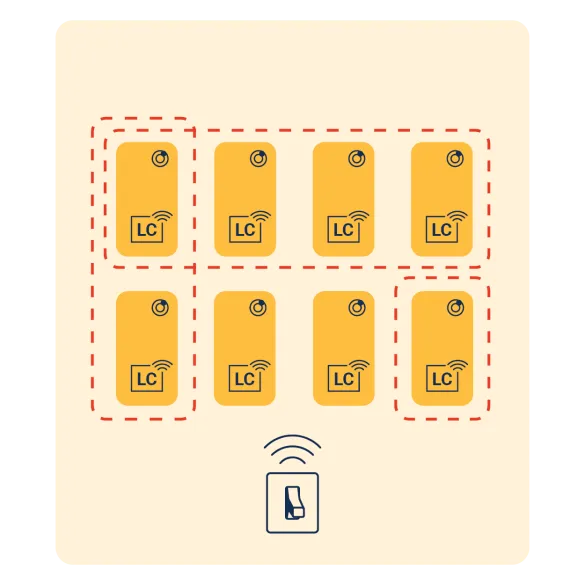
| LLLC Systems Generate Savings Over Their Entire Lifecycle |
LLLCs can be zoned in any configuration without rewiring. |
|---|---|
|
By contrast, LLLC systems are flexible and easy to configure. Just as smartphones have integrated cameras and GPS, LLLCs integrate sensors and load controllers into every fixture. These integrated solutions allow spaces to be rezoned in just about every configuration imaginable. The combination of flexibility and ease of use means that LLLC solutions can adapt to as-built scenarios without requiring additional materials or labor. It also ensures that if space needs change the lighting system can adapt by opening and adjusting settings in an app instead of hiring an electrician. |
|
LLLCs outperform the competition throughout the product lifecycle
Contractors should cite the following advantages when proposing LLLCs over code-minimum solutions like standalone controls to achieve desired outcomes throughout different project phases
| Desired Outcome | Standalone Controls | LLLC Solution | |
|---|---|---|---|
| PROJECT PLANNING |
Streamline Mitigate value |
Requires design plans for More susceptible to cost |
Automatically, meets all control System flexibility preserves design |
| PROJECT INSTALLATION |
Smooth installation | Commonly require conduit and wire, which slows installation and introduces construction variables |
LLLC systems have sensors integrated at the factory and make use of reliable wireless communication technology to streamline installation and reduce material costs |
| OPERATIONS & MAINTENANCE |
Ease of use | Standalone control systems are cumbersome to program and often involve manually programming multiple sensors per room |
LLLC systems can program entire zones with the click of a button. Modern app-based configuration tools provide confidence in system settings and help document the sequence of operations |
| CUSTOMER EXPERIENCE |
Low operating Space comfort |
Offer minimum energy Challenging and |
LLLC systems have been proven LLLC systems make it easy to |